
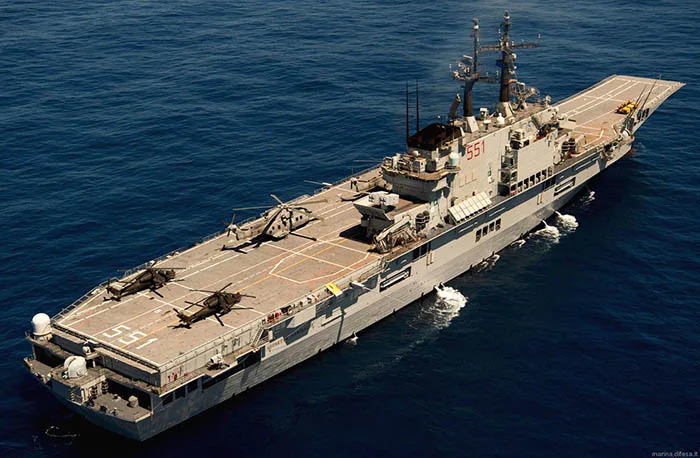
Jakarta, indomaritim.com – The Giuseppe Garibaldi is expected to arrive in Indonesia soon, marking a historic milestone as the Indonesian Navy prepares to operate an aircraft carrier for the first time.
Built by Italian shipbuilder Fincantieri, the vessel will depart from Italy and is expected to arrive in Indonesia on September 20, 2026.
According to Antara News Agency, plans to acquire the Giuseppe Garibaldi have been discussed since early 2025.
Several acquisition schemes were reported during the planning process to purchase the Garibaldi. The aircraft carrier was ultimately acquired as a grant from the Italian government.
However, the transfer is not without cost. The more then 40 years old vessel requires extensive retrofitting and modernization to meet the needs of the Indonesian Navy’s combat capability.
The modernization is estimated to cost between Rp7.2 trillion (US$378 million) and Rp16.8 trillion (US$909 million).
Despite requiring significant upgrades, the aircraft carrier retains capabilities that are not available in the Indonesian Navy’s existing fleet.
Specifications
Director General of Defense Forces at the Ministry of Defense, Rear Marshal Hendrikus Haris Haryanto, presented the vessel’s specifications during a hearing with Commission I of the House of Representatives (DPR) at the Parliament Complex in Jakarta on July 20.
The Giuseppe Garibaldi measures 180 metres in length and 33 metres in width, with a full-load displacement of around 13,850 tonnes.
It can reach a top speed of 30 knots and has a cruising range of 7,000 nautical miles at 20 knots.
The vessel can carry up to 18 helicopters and 16 fighter jets, depending on its mission configuration, and is equipped with a range of weapon systems designed to strengthen its defensive capabilities.
Completed in 1983, the aircraft carrier can accommodate a crew of up to 550, significantly exceeding the capacity of the KRI Brawijaya-320, which only has around 203.
Government preparations
To operate the carrier, the Indonesian Navy has sent 100 prospective crew members to Italy for theoretical and practical training.
The aircraft carrier will sail to Indonesia with a joint crew concept, manned by personnel from the Indonesian Navy and the Italian Navy to facilitate the adaptation process and transfer of knowledge.
Head of the Indonesian Navy Information Service, Commodore Tunggul, said additional training batches may be required, as the aircraft carrier requires a crew of 500 personnel.
The government is also preparing supporting infrastructure, including the Lampung Naval Base, which is projected to become one of Garibaldi’s home bases.
As of July 2026, construction of the facility had reached approximately 76 percent completion.
Besides preparing personnel and supporting infrastructure, the Indonesian Navy is also selecting a new name for the aircraft carrier.
The vessel will not retain the name Giuseppe Garibaldi, which honours the 19th-century Italian revolutionary who played a leading role in Italy’s unification.
The Navy Chief of Staff Admiral Muhammad Ali said the ship would be named after a national figure.
Proposed names include Gajah Mada and Commander Soedirman. The shortlisted names will be submitted to President Prabowo Subianto and Defense Minister Sjafrie Sjamsoeddin for final approval.
The selected name will officially be bestowed on the vessel upon its arrival in Indonesia later this year.
The need for an aircraft carrier
Many countries regard aircraft carriers as symbolizing the navy’s ability to conduct long-range military operations, from safeguarding strategic interests to supporting military operations outside its territorial waters.
The Indonesian Navy, however, emphasized that acquiring the aircraft carrier does not signal a move toward an offensive defence strategy.
Admiral Muhammad Ali stated that the Navy is building its strength toward the Blue Water Navy concept, a navy capable of operating across oceans.
According to Muhammad Ali, the presence of an aircraft carrier is a key element in supporting that capability.
Ali also stressed that the aircraft carrier is not being prepared for offensive purposes.
The carrier is more geared towards supporting defense diplomacy, port visits, humanitarian assistance, and military operations other than war (OMSP).
“We may be able to become a Blue Water Navy, but not for invasion. The aircraft carrier will support goodwill diplomacy activities, port visits, for example, military operations other than war (OMSP), and humanitarian assistance, and those are very functional and beneficial,” the admiral ensured.
Expert views
Amid growing public interest in the arrival of the Giuseppe Garibaldi, several experts and academics have cautioned that operating the aircraft carrier will also present a number of challenges.
Defense analyst Gerry Soejatman said the Garibaldi would be better utilized as a light aircraft carrier supporting logistics operations, humanitarian aid, and OMSP rather than a main aircraft carrier for long-range combat operations.
He also reminded of the high maintenance costs of the carrier.
Additionally, Ace Hasan Syadzily, Governor of the National Resilience Institute of the Republic of Indonesia (Lemhannas), said procuring the aircraft carrier was an appropriate move considering Indonesia’s vast maritime territory.
He also reminded the government to carefully assess its fiscal capacity to finance the vessel’s modernization and long-term operational costs.
Furthermore, Achmad DG Sere, a member of Commission I of the Indonesian House of Representatives (DPR RI), also supports the arrival of the carrier.
He said the ship’s procurement should involve domestic defense industries, such as the state-owned shipbuilding company, PT PAL, so the technology transfer process can strengthen Indonesia’s industrial capability and human resources.
While the Giuseppe Garibaldi is expected to arrive in Indonesia soon, the greater challenge will begin after it is commissioned into the Indonesian Navy fleet to strengthen maritime defence and protect the nation’s sovereignty.
“National sovereignty carries a hefty price tag. It is not just about buying military equipment; ensuring the country’s sovereignty requires far greater investment,” Defense Minister Sjafrie Sjamsoeddin said. (RR)





Komentar