
Sebatik, North Kalimantan, indomaritim.com – Indonesia, the world’s largest archipelago, stretches across the equator with more than 17,000 islands scattered between the Pacific and Indian oceans, including Sebatik, a small island divided between Indonesia and Malaysia.
Sebatik lies off Kalimantan’s eastern coast and covers about 452.2 square kilometers. Its unusual position makes it a strategic frontier where two countries share an island but separate jurisdictions.
According to Antara News Agency, the island is divided by the Indonesia-Malaysia border. Its southern section belongs to Nunukan District in North Kalimantan, while the northern section is part of Malaysia’s Sabah State.
The boundary has not remained entirely fixed. Indonesia and Malaysia have worked together to settle outstanding border issues, including a recent adjustment involving territory on Sebatik.
For residents, the border is more than a line on a map. It shapes daily life, trade and cultural ties among Indonesians and Malaysians living on opposite sides.
Sebatik’s strategic location has drawn greater attention from Jakarta, prompting efforts to protect territorial sovereignty while improving infrastructure and welfare for communities living along the frontier.
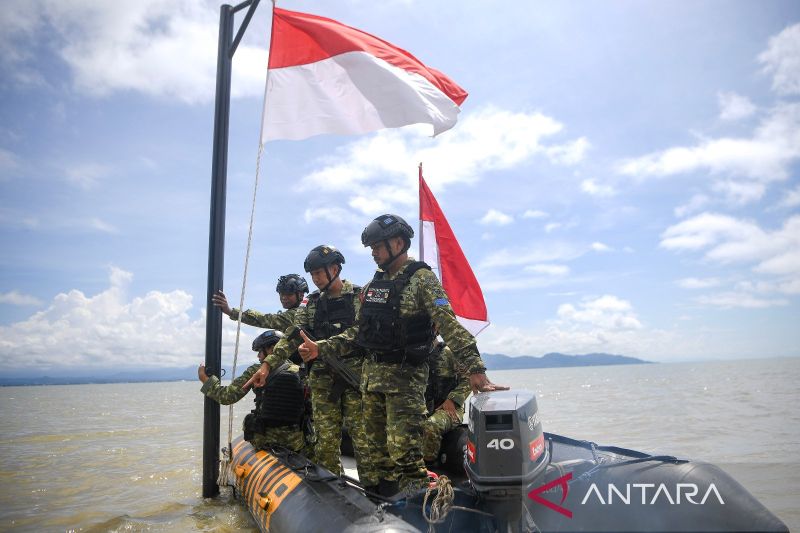
The Indonesian Navy’s Marine Corps has become a key force on the island, combining border security duties with efforts to support residents on the Indonesian side.
Marines conduct regular patrols along the coast and at vulnerable points, seeking to prevent smuggling, illegal trade and other activities that could threaten Indonesia’s sovereignty.
Led by Marine Captain Ahmad Rizwan, the border task force conducts vessel inspections and land and sea patrols to monitor activity and safeguard the boundary.
The Marines work with Indonesian Army units and other forces to protect about 144 border markers that define the Indonesia-Malaysia boundary across Sebatik.
While several agencies share responsibility, the Marines focus particularly on the coastline.
They guard small docks and inspect cargo to prevent prohibited goods, including narcotics and alcoholic beverages.
Their vigilance extends beyond cargo. Marines also check the identities of people entering or leaving through small docks, helping prevent unauthorized cross-border movement.
Surrounded by water, Sebatik provides a natural setting for amphibious operations. The Marines’ mobility at sea gives them an important role in maintaining security across the island’s frontier.
Beyond the Call of Duty
Indonesians have increasingly relied on firefighters for tasks beyond emergencies, from removing snakes and wasp nests to freeing trapped limbs or handling other unusual requests from residents.
On Sebatik, however, marines often fill a similar role. Their mission extends beyond sovereignty, bringing security and community assistance together in ways that have become part of island life.
Sebatik residents have developed confidence in the Marines’ ability to handle problems beyond conventional security duties. Years of interaction have encouraged locals to seek their help during emergencies.
That relationship is reflected in the steady stream of messages reaching Captain Rizwan’s phone. One alert recently said a resident needed AB-type blood while the local health center lacked supplies.
Rizwan quickly turned to his personnel. A marine volunteered to donate blood, showing how troops stationed to protect the frontier can also become a vital source of assistance.
The task force also includes medical personnel who regularly provide health counseling, particularly to older residents. They visit homes, offer information and provide treatment when necessary.
On one occasion, a family asked marine medics to treat an elderly person with an abrasion on the leg. The team quickly provided care and helped the wound begin healing.
The request was not the most unusual. Another elderly resident once asked the Marines for help climbing a mango tree to harvest its fruit.
The Marines also visit schools on the Indonesian side, providing education and counseling alongside their border-security duties and building relationships with younger residents.
At Public Senior High School Sebatik 1, the Marines marked National Children’s Day 2026 in late July with a session focused on patriotism and national identity.
Captain Rizwan took on the role of lecturer, encouraging students to strengthen their sense of belonging to Indonesia, including by using the rupiah in everyday transactions.
The challenge of securing border areas stems not only from geography but also from social dynamics. Human-centered engagement has therefore become an important part of the Marines’ mission.
That approach has helped make the task force a welcome presence among Sebatik residents. Locals sometimes bring rice, fruit or fish to the base to express their appreciation.
The closeness is particularly visible in the afternoons, when the volleyball court inside the military compound fills with community activities, bringing soldiers and civilians together.
For communities far from government centers and with limited facilities, the troops’ presence represents a visible sign of the state at Indonesia’s frontier.
On Sebatik, protecting sovereignty is not only about weapons, patrols and border markers. It also means maintaining a presence in homes, classrooms and farmlands where national identity is lived daily. (Edo)

Komentar