
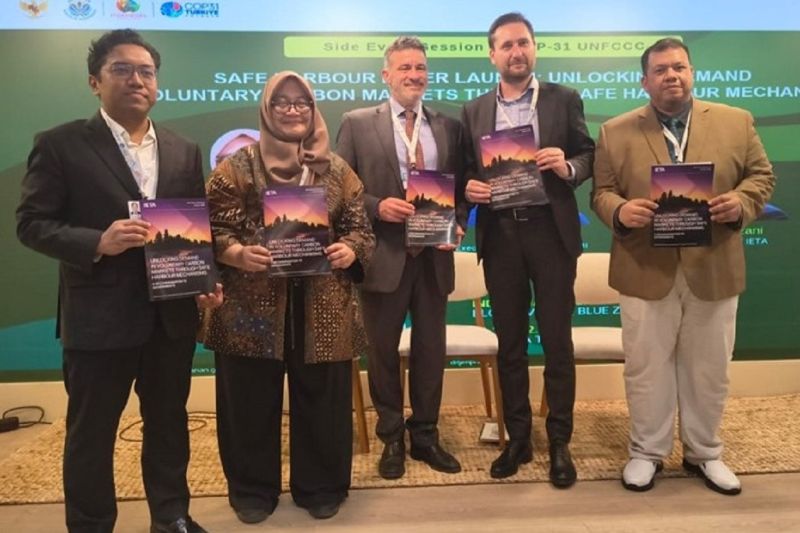
Jakarta, indomaritim.com – Indonesia welcomes the “safe harbour” mechanism to provide legal certainty for carbon credit buyers and investors, boost demand for high-quality credits, and advance its ambition to become a global forest carbon hub.
Laksmi Wijayanti, Director General of Sustainable Forest Management of the Forestry Ministry, stated that the growth of the carbon market cannot rely solely on the availability of credits.
“The market also requires buyer confidence, legal certainty, and guarantees that carbon credits genuinely reflect emissions reductions, ensuring they are not merely a form of ‘greenwashing’,” Wijayanti said in a statement in Jakarta on Sunday as cited from Antara News Agency.
According to her, companies currently face both legal and reputational risks when purchasing carbon credits or making public claims regarding their use.
She noted that such uncertainty could discourage investment, including in projects that generate high-quality carbon credits.
A safe harbour mechanism provides a legal protection framework for companies that use carbon credits in compliance with established requirements and standards, with the aim of encouraging their participation in voluntary carbon markets.
The report was prepared by the International Emissions Trading Association (IETA), with support from the Coalition to Grow Carbon Markets (CGCM), to help increase demand for carbon credits in international voluntary carbon markets. Indonesia is one of 14 countries that have joined the CGCM.
Ilham, the Forestry Ministry’s Director of Forest Utilization Business Development, said Indonesia was strengthening its carbon trading regulations through safe harbour approaches, internationally aligned contracts incorporating social safeguards, and dispute resolution mechanisms.
“These improvements provide greater legal certainty for transactions while ensuring that carbon market development remains consistent with national green economic development policies and Indonesia’s climate commitments,” he said.
He emphasized that the legal protection provided under a safe harbour mechanism did not amount to immunity, as its implementation remained subject to Indonesia’s national laws and sovereignty. The implementation of this mechanism could also strengthen international market confidence, potentially supporting Indonesia’s ambition to become an “International Forest Carbon Hub” and a benchmark for international voluntary carbon trading.
Mark Kenber, executive director of the Voluntary Carbon Markets Integrity Initiative (VCMI), explained that a safe harbour mechanism was not a substitute for national regulations but rather complemented them. Companies would still be required to comply with the laws and regulations of the countries in which they operate.
The safe harbour mechanism covers two key aspects: the quality of carbon credits and the accuracy of corporate claims.
Carbon credits must comply with recognized standards and frameworks, including the Paris Agreement’s Article 6.4 mechanism, the Integrity Council for the Voluntary Carbon Market (ICVCM), the Carbon Offsetting and Reduction Scheme for International Aviation (CORSIA), and frameworks established by individual national governments.
Meanwhile, claim accuracy concerns how companies communicate their use of carbon credits to the public. They must provide accurate information and avoid creating the impression that they have eliminated all their emissions when they have actually only offset them through the purchase of carbon credits. (Dul)












Komentar