
Support by SAMUDRA PELAUT TRUST DESA
The architecture of global power is undergoing a profound transformation. For centuries, geopolitical authority has been anchored in the control of land and sea—territorial borders, maritime dominance, and access to natural resources. In the 21st century, however, this paradigm is being redefined by the rise of digital economies, artificial intelligence, and cloud-based systems, which elevate data into a strategic resource comparable to oil in the industrial age. Crucially, more than 95 percent of global internet traffic flows through submarine cables laid across the ocean floor, forming the invisible backbone of global finance, communication, logistics, and governance. As a result, power is no longer determined solely by geography in its traditional sense, but by the ability to control, secure, and direct the flow of data beneath the oceans. This shift signals the emergence of what can be described as infrastructural sovereignty, where influence is exercised through mastery over critical digital systems rather than purely through territorial control.
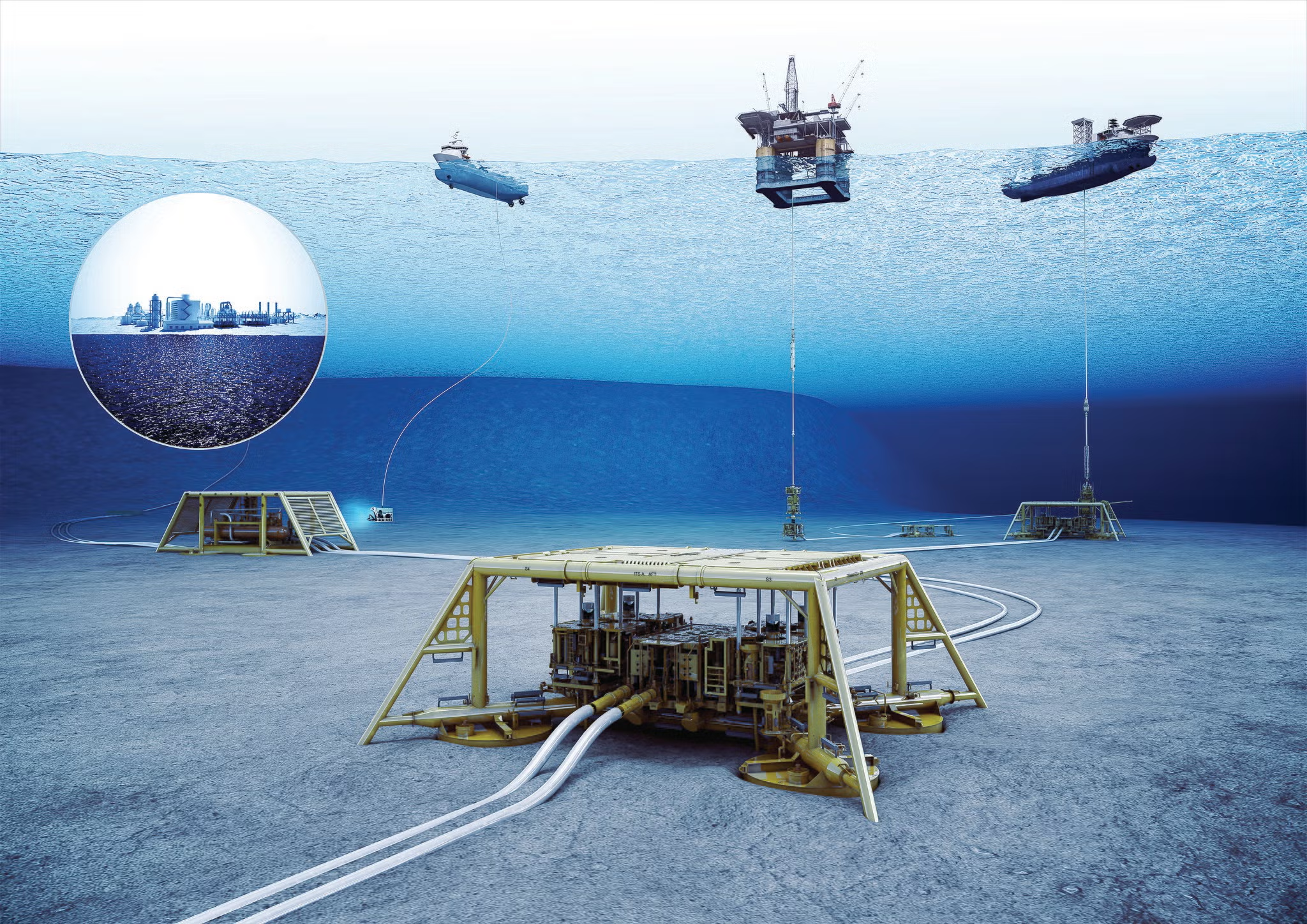
The subsea domain has therefore evolved into a strategic frontier where physical geography intersects with digital infrastructure. Submarine cables, subsea data centers, and cable landing hubs now constitute a distributed yet highly concentrated architecture of global connectivity. Submarine cables serve as high-capacity conduits for international data transmission, while subsea data centers—once experimental—are now entering commercial deployment, leveraging natural seawater cooling to improve energy efficiency and operational sustainability. Cable landing hubs, positioned along coastlines, function as critical nodes where subsea systems connect with terrestrial networks and data centers, creating points of interconnection that determine how and where data flows. Together, these elements form a layered system of control that extends beyond national borders, embedding power within infrastructure rather than territory alone.
Recent developments in China, Australia, and Mexico illustrate three distinct models of how states and industry actors are navigating this transformation. China’s deployment of commercial subsea data centers in Hainan reflects a centralized, state-driven approach focused on control, efficiency, and digital sovereignty. By extending computational infrastructure into the maritime domain, China not only reduces energy consumption through natural cooling but also strengthens its ability to manage data flows within a sovereign framework. This approach aligns with a broader strategy of reducing dependence on foreign technological systems while enhancing resilience against external disruptions. However, it also introduces tensions around global trust and interoperability, particularly among nations concerned about centralized control over critical infrastructure.
In contrast, Australia’s strategy emphasizes resilience and security. Through initiatives led by companies such as SUBCO, the country is developing geographically diverse network routes that ensure continuity even in the face of disruption. By integrating subsea and terrestrial systems into hybrid architectures, Australia minimizes the risk of single points of failure and enhances the survivability of its digital infrastructure. This approach reflects a security-oriented doctrine in which connectivity is treated as a critical national asset, requiring redundancy, physical separation, and strategic planning. In an era marked by increasing cyber threats and geopolitical tensions, such resilience is essential not only for economic stability but also for national defense.
Mexico, through the MANTA project, presents a third model based on openness and interconnection. By establishing carrier-neutral cable landing hubs in strategic coastal locations, supported by actors such as Liberty Networks and Sparkle, Mexico is positioning itself as a regional digital gateway linking North and Latin America. This model encourages participation from multiple operators, cloud providers, and digital platforms, creating an ecosystem that benefits from network effects. Rather than prioritizing control or security alone, Mexico’s strategy focuses on enabling flows and maximizing connectivity, transforming geographic position into economic leverage. This open-access approach lowers barriers to entry, attracts investment, and accelerates innovation, although it also introduces dependencies on global actors.
These three approaches—control, resilience, and openness—highlight the multifaceted nature of power in the digital age. While differing in implementation, they converge on a shared recognition that infrastructure beneath the sea is central to global influence. Control over data flows enables states and corporations to shape financial transactions, communication networks, and even strategic decision-making processes. In times of crisis, the ability to reroute, secure, or disrupt these flows becomes a form of leverage comparable to traditional military or economic tools. At the same time, the divergence of models raises the risk of fragmentation, as competing visions of digital governance may lead to the emergence of parallel systems or a “splintered” internet divided along geopolitical lines.
The growing importance of subsea infrastructure also blurs the boundary between civilian and military domains. Although submarine cables and data centers are primarily commercial assets, their strategic value makes them potential targets in geopolitical competition. Disruptions—whether caused by natural disasters, technical failures, or deliberate actions—can have cascading effects across economies and societies. As such, the governance of these systems requires a new framework that integrates economic policy, technological development, and national security considerations.
For emerging and archipelagic states, this transformation presents both opportunity and risk. Countries with strategic geographic positions, particularly those located along major cable routes, have the potential to become critical nodes in the global digital network. However, without sufficient investment in infrastructure, regulatory frameworks, and technological capabilities, they risk remaining passive transit zones rather than active centers of control. Indonesia, for example, occupies a pivotal position in the Indo-Pacific, yet its ability to influence data flows depends on its capacity to develop integrated landing hubs, promote open yet sovereign interconnection ecosystems, and strengthen network resilience. Transitioning from a transit role to a controlling role requires a deliberate strategy that aligns economic, technological, and security objectives.
Ultimately, the geography of power is being redefined. Land and sea remain important, but they are no longer sufficient to explain global influence. Beneath the oceans lies a complex and largely invisible infrastructure that sustains the digital world and shapes its future. The cases of China, Australia, and Mexico demonstrate that power in the 21st century is increasingly exercised through the ability to govern the flow of data across this infrastructure. Nations that understand and act upon this reality will shape the emerging global order, while those that do not may find themselves constrained by systems designed and controlled by others.










Komentar