
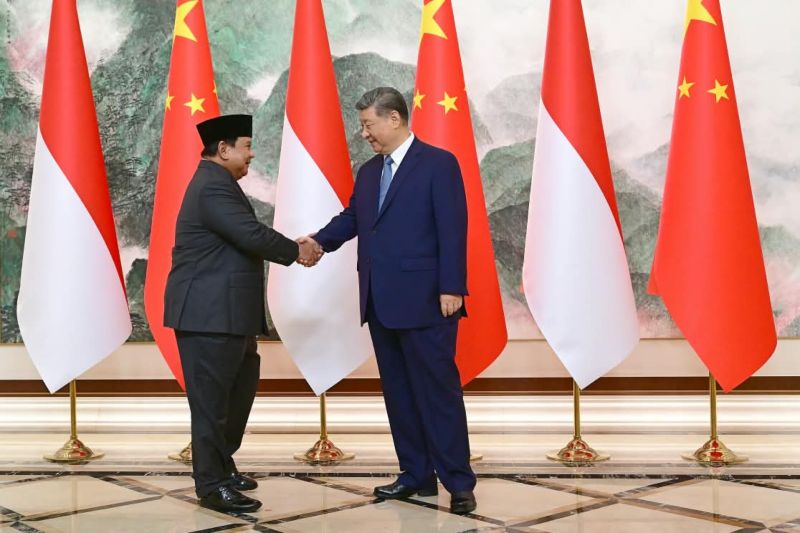
Jakarta, indomaritim.com – President Prabowo Subianto’s visit to China in November 2026 yielded several concrete outcomes aimed at strengthening economic relations between the two countries, particularly in trade and investment.
Amid global economic uncertainty and the restructuring of global supply chains, Indonesia secured business cooperation commitments worth tens of billions of US dollars.
One of the key outcomes was the signing of 35 memorandums of understanding (MoUs) between Indonesian and Chinese businesses, worth US$15 billion, at the 2026 Indonesia–China Business Forum in Shenzhen on November 20.
These agreements add to the US$71.8 billion in cooperation commitments witnessed by President Prabowo on November 18, bringing the total value of investment and economic agreements reached during the visit to a potential US$86.8 billion.
The 35 MoUs cover various strategic sectors, including industrial estates, petrochemicals, new and renewable energy, manufacturing, electric vehicles, digital technology, data centers, pharmaceuticals and vaccines, and infrastructure.
These areas reflect the expanding scope of the partnership, which is no longer limited to commodity trade but increasingly encompasses industrial capacity development, technology, and infrastructure to strengthen the foundations of Indonesia’s national economy.
The collaboration also aligns with the government’s development priorities, including food security, mineral downstreaming, new energy, the digital economy, biotechnology, manufacturing, infrastructure, and logistics.
The China Committee of the Indonesian Chamber of Commerce and Industry (KIKT) recorded that the 2024 Indonesia–China Business Forum in Beijing generated cooperation commitments worth US$10.7 billion. The increase in the value of agreements this year reflects strong confidence among Chinese business partners in Indonesia’s economic prospects.
These investment commitments are expected to create more than 30,000 domestic jobs. Beyond attracting additional capital, the partnership is also expected to facilitate technology transfer, improve workforce skills, and generate greater added value for the Indonesian economy.
Trade and Investment
Minister of Trade Budi Santoso said the commitments made by President Prabowo Subianto and Chinese President Xi Jinping must be followed by concrete economic cooperation, including stronger bilateral trade ties and investments that generate greater added value for both economies.
Santoso said mutual trust and mutually beneficial business relations were fundamental to strengthening the economic partnership.
He added that this required credible cooperation and a commitment to protecting the interests of both parties.
China is currently Indonesia’s largest trading partner and one of its major sources of foreign investment.
Bilateral trade reached US$132.13 billion in January–September 2026, with Indonesian exports totaling US$55.47 billion and imports reaching US$76.67 billion.
Throughout 2025, total trade between Indonesia and China stood at US$154.37 billion, with Indonesian exports amounting to US$66.96 billion and imports reaching US$87.41 billion.
Indonesia’s main exports to China include ferroalloys, nickel matte, lignite, coal, and copper ores and concentrates.
Meanwhile, Indonesian imports from China are dominated by telephones, including smartphones, automatic data processing machines, passenger vehicles, chemicals used in the electronics industry, and heavy equipment such as bulldozers and excavators.
The substantial trade volume highlights the close economic interdependence between the two countries, while also presenting opportunities to increase the added value of Indonesian products by strengthening the processing industry and diversifying exports.
In terms of investment, realized Chinese investment in Indonesia reached US$7.5 billion in 2025, making China Indonesia’s third-largest source of foreign investment.
Strengthening Downstreaming Industry
Energy and mineral resources have also emerged as key sectors in strengthening the Indonesia-China partnership.
The government aims to ensure that incoming investment goes beyond the extraction of raw natural resources and contributes to expanding domestic industrial capacity to process raw materials into higher-value products.
Energy and Mineral Resources Minister Bahlil Lahadalia, who also serves as Coordinating Minister for Downstreaming and Energy Transition, stated that efforts to deepen bilateral relations must translate into concrete cooperation that facilitates technology transfer, improves workforce skills, and strengthens national energy security.
Cooperation in the minerals sector has been formalized through two memorandums of understanding signed on November 9, 2024.
These agreements cover green minerals cooperation between Indonesia’s Ministry of Energy and Mineral Resources and China’s Ministry of Commerce, as well as cooperation on mineral resources with China’s National Development and Reform Commission (NDRC).
The agreements cover several areas, including mineral processing and refining, investment and infrastructure development, and technological advancement, while taking environmental, social, and governance (ESG) principles into account.
The partnership is also reflected in the development of an integrated electric vehicle battery ecosystem by the ANTAM–IBC–CBL consortium in East Halmahera, North Maluku, and Karawang, West Java.
The project is designed to integrate the entire battery production chain, from nickel mining and processing to the production of battery materials and cells, as well as battery recycling.
In the renewable energy sector, Trina Solar’s collaboration with PT Trina Mas Agra Indonesia has resulted in the establishment of a solar cell and module manufacturing facility in Kendal, Central Java. The facility is intended to support the domestic supply chain for solar power plant (PLTS) development.
Meanwhile, Chinese companies are also involved in Indonesia’s gas sector through the construction of a floating liquefied natural gas (FLNG) facility for the Genting project by China’s Wison New Energies. With a designed capacity of 1.2 million tons of LNG per year, the facility is being developed to process gas from the Asap Kido Merah Field in the Kasuri Block, Bintuni Bay, West Papua.
Advancing Economic Cooperation
Beyond the US$15 billion in agreements reached at the business forum, President Prabowo’s visit to China also resulted in several major commitments in technology, manufacturing, and infrastructure.
These include plans to develop 10 initial locations for future smart cities through a partnership between PT Kota Masa Depan Indonesia, a subsidiary of Danantara, and a consortium led by Shaanxi, involving an investment of approximately US$50 billion.
Other collaborations include an approximately US$10 billion commitment from Hisense to expand its presence in Indonesia. The plans encompass the construction of joint research and development laboratories, talent development programs, and home appliance manufacturing facilities.
Danantara is also strengthening its infrastructure financing partnership with a consortium led by the State Development and Investment Corporation (SDIC), with a commitment valued at approximately US$10 billion.
Meanwhile, Indonesia’s Ministry of Higher Education, Science, and Technology, Pertamina, and Beijing Petrochemical Engineering Co., Ltd., have agreed to develop coal-to-ethanol technology through a partnership valued at US$1.8 billion.
These agreements reflect the evolving Indonesia-China partnership, which is moving beyond conventional trade and investment toward greater cooperation in technology development, future industries, and infrastructure to support economic growth.
Amid intensifying global competition for investment, Indonesia must now focus on translating these commitments into tangible projects. Regulatory certainty, adequate infrastructure, a skilled workforce, and technology transfer will be essential to ensuring that these investments deliver sustainable, long-term benefits. (Edo)







Komentar