
Support by PELAUT SAMUDRA TRUST DESA
From Strategic Crossroads to Geopolitical Pivot
The rapid evolution of the India–Australia strategic partnership is often interpreted through the lens of balancing China’s growing influence in the Indo-Pacific. Such an interpretation, while partially correct, fails to capture the deeper structural transformation currently unfolding across the world’s most important maritime region. What is emerging is not merely a new security arrangement between two middle powers, but a broader reconfiguration of the global maritime order in which the strategic value of Southeast Asia—and Indonesia in particular—is rising dramatically.
For centuries, geography has shaped the rise and decline of great powers. In the twenty-first century, however, geography is being redefined by connectivity. The most valuable territories are no longer necessarily those with the largest armies or the richest mineral deposits, but those that connect critical flows of energy, trade, information, and technology. In this regard, Indonesia occupies one of the most consequential geographical positions on Earth. Situated between the Indian and Pacific Oceans and astride some of the world’s most critical sea lanes, Indonesia sits at the center of a maritime system upon which global prosperity increasingly depends.
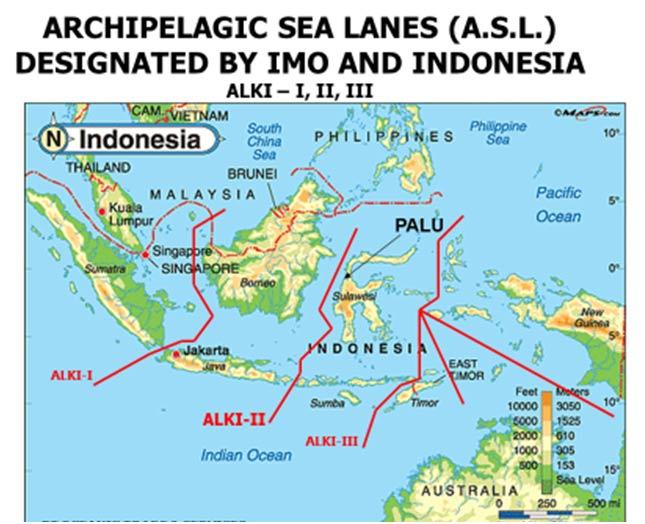
The significance of this position becomes clearer when viewed through the broader dynamics of Indo-Pacific trade. More than one-third of global commerce passes through Southeast Asian waters. A substantial share of the energy consumed by East Asia originates in the Middle East and travels through a maritime corridor linking the Persian Gulf, the Indian Ocean, the Strait of Malacca, the Singapore Strait, and the Indonesian archipelagic sea lanes before reaching China, Japan, South Korea, and other industrial economies. These routes are not merely shipping lanes; they are the arteries of the global economy. Any disruption along them would trigger cascading consequences across supply chains, financial markets, manufacturing networks, and energy systems worldwide.
Within this maritime architecture, Indonesia holds a uniquely strategic position. While the Strait of Malacca has traditionally attracted the greatest attention due to its role as the shortest route between the Indian and Pacific Oceans, the strategic importance of the Sunda and Lombok Straits has grown considerably. As vessels become larger and geopolitical competition intensifies, these alternative passages are increasingly viewed as essential components of global maritime resilience. The Lombok Strait, in particular, possesses the depth required for large naval vessels, aircraft carriers, and strategic submarines, making it highly relevant for both commercial and military navigation. In an era where maritime security and economic security have become inseparable, Indonesia’s control over these corridors grants it geopolitical significance far beyond its immediate region.
The growing maritime cooperation between India and Australia reflects this changing reality. Both countries recognize that the future balance of power in the Indo-Pacific will depend not only on military capabilities but also on the ability to secure maritime connectivity. Their efforts to enhance naval interoperability, maritime domain awareness, intelligence sharing, and defense-industrial cooperation are part of a larger attempt to preserve open sea lanes and ensure that no single power can dominate the region’s critical chokepoints. While China remains an important factor in this strategic calculus, the underlying objective is broader: the preservation of a stable maritime order capable of supporting uninterrupted economic exchange.
For ASEAN, these developments present both opportunities and challenges. On one hand, the increasing attention directed toward Southeast Asia enhances the region’s strategic relevance. On the other hand, it places ASEAN at the center of intensifying competition among major powers. The concept of ASEAN Centrality, long regarded as a cornerstone of regional diplomacy, now faces a critical test. Centrality can only be sustained if it is supported by credible maritime capabilities, economic resilience, and institutional cohesion. Otherwise, ASEAN risks becoming the object rather than the architect of regional order.
Indonesia’s role within this evolving landscape is particularly significant. Unlike many nations whose geopolitical importance derives from military power or economic scale alone, Indonesia’s strategic value stems from its ability to connect multiple regions simultaneously. It links the Indian Ocean to the Pacific, the Middle East to East Asia, Australia to continental Asia, and increasingly, global digital infrastructure through submarine communication cables that traverse its waters. As global competition expands beyond conventional military domains into data, energy, logistics, and undersea infrastructure, Indonesia’s maritime territory becomes a critical component of international stability.
Yet geography alone does not guarantee influence. History offers numerous examples of nations that possessed extraordinary geographic advantages but failed to convert them into strategic power. The challenge facing Indonesia is therefore not one of location but of transformation. To fully realize its maritime potential, Indonesia must invest in deep-water ports, advanced maritime surveillance systems, naval modernization, shipbuilding industries, maritime research, and blue economy initiatives. Equally important is the development of a strategic culture that views the sea not as a barrier separating islands, but as a unifying space that generates national power and international relevance.
This distinction is fundamental. For centuries, major maritime powers—from Britain to the United States—understood that control of the sea was not merely about naval dominance. It was about shaping the movement of goods, capital, people, information, and influence. In the emerging Indo-Pacific order, Indonesia possesses many of the geographic attributes necessary to play a similar role. The question is whether it can develop the institutional capacity, strategic vision, and maritime infrastructure required to translate those attributes into lasting influence.
The partnership between India and Australia therefore offers a broader lesson. It demonstrates that the future of the Indo-Pacific will be determined less by territorial conquest than by the management of maritime connectivity. Nations that can secure and shape the flow of global commerce will possess disproportionate influence over the international system. In this context, Indonesia is not merely located at the crossroads of two oceans. It is increasingly becoming the pivot around which the maritime future of the Indo-Pacific may turn.
The ultimate strategic question for Indonesia is no longer whether it is geographically important. Geography has already answered that question. The more consequential challenge is whether Indonesia can transform its position from a passive transit zone into an active maritime power capable of shaping the rules, institutions, and flows that define the twenty-first century. If it succeeds, Indonesia will emerge not only as Southeast Asia’s largest nation but as one of the principal architects of the new maritime century.





Komentar